
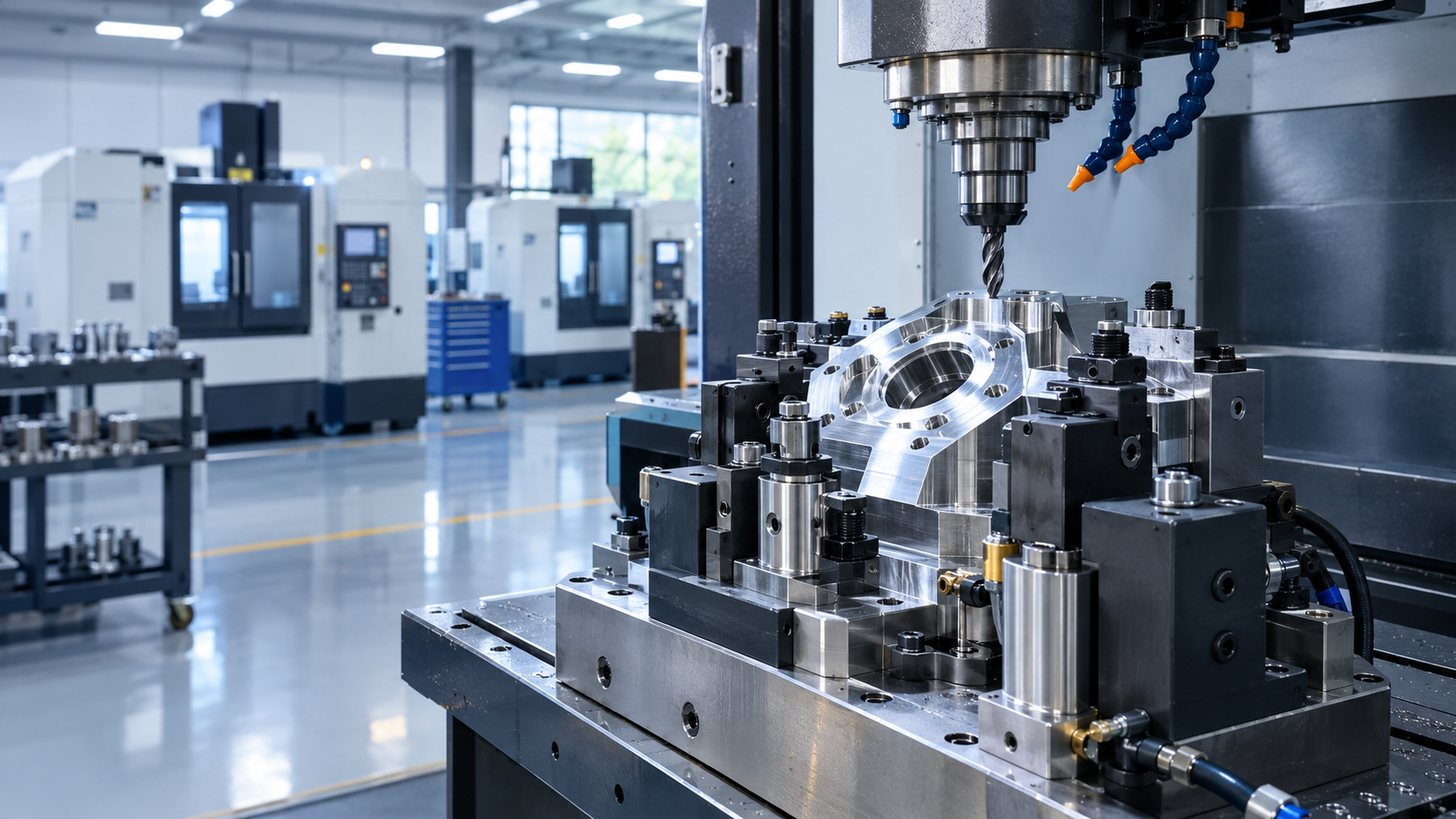
A machining line can have the right CNC, the right cutting tools, and a well-programmed part, and still run into trouble at one point: the fixture. If a component isn't held and located correctly, every downstream process inherits that error—accuracy suffers, cycle times stretch, and repeatability becomes a daily struggle rather than a given.
This is why choosing a CNC workholding fixture manufacturer in India is not a purely transactional decision. The fixture partner you select influences machining accuracy, cycle time, repeatability, operator efficiency, production capacity, and ultimately, your overall manufacturing cost. Getting this decision right upfront saves far more time than it costs.
This guide walks through what a workholding fixture actually does, why the manufacturer matters as much as the fixture itself, and how to evaluate potential partners before you place an order.
What Is a CNC Workholding Fixture?
A CNC workholding fixture is a tooling device that holds and locates a component securely during machining, so the cutting tool can remove material accurately and consistently, part after part.
At its core, a fixture does two jobs:
- Locating the component in a fixed, repeatable position relative to the machine spindle
- Clamping it firmly enough to resist cutting forces without distorting the part
A generic or standard fixture may work for simple, low-precision components. But most production components—brackets, housings, manifolds, castings, and machined forgings—have unique geometry, datum requirements, and clamping constraints. This is where an application-specific or custom CNC fixture becomes necessary, designed around the exact part, process, and machine it will run on.
Why Choosing the Right Fixture Manufacturer Matters
The fixture is often treated as a support item, but its design directly shapes production outcomes.
Machining Accuracy and Repeatability
If locating points are poorly chosen or clamping force is inconsistent, every part in the batch can carry a slightly different error. A well-engineered fixture holds the same datum reference cycle after cycle, which is what makes repeatability possible.
Production Cycle Time
Fixtures that require multiple manual adjustments before each cycle add non-productive time. A fixture designed with the process in mind—correct clamp placement and minimal repositioning—reduces idle machine time.
Component Loading and Unloading
In high-volume production, even a few extra seconds per load-unload cycle compounds into significant lost capacity over a shift. Fixture layout should support quick, ergonomic loading without compromising locating accuracy.
Tool Accessibility
A fixture that blocks tool paths or forces awkward tool angles limits what operations can be completed in a single setup. Good fixture design considers the entire machining sequence, not just the clamping step.
Fixture Life and Maintenance
Fixtures used in continuous production see repeated clamping cycles, chip exposure, and coolant contact. Material selection and build quality determine how long a fixture holds its accuracy before it needs rework.
Key Factors to Consider When Choosing a CNC Workholding Fixture Manufacturer
1. Engineering and Design Capability
A capable manufacturer studies the component drawing, understands critical dimensions and tolerances, and works out a clamping and locating strategy before any fixture is built. This includes evaluating datum structure, clamping force direction, and manufacturability of the fixture itself—not just replicating a rough sketch.
2. Experience With Different Fixture Types
Different production scenarios call for different fixture technologies:
- Mechanical fixtures: Manually operated clamps suited to lower-volume or simpler components where cost efficiency matters more than cycle speed.
- Hydraulic fixtures: Used where consistent, high clamping force is needed across multiple points simultaneously, common in complex or heavier components.
- Pneumatic fixtures: Favoured where faster cycle times and quick load-unload are priorities, typically in higher-volume production.
- VMC fixtures: Designed for vertical machining centres, generally for components machined predominantly from the top.
- HMC fixtures: Designed for horizontal machining centres, often supporting multi-sided machining in a single setup.
A manufacturer with genuine experience across these types can recommend the right approach rather than defaulting to whatever they build most often.
3. Customisation Capability
Two components that look similar on paper can require entirely different workholding solutions. The right fixture depends on:
- Component geometry
- Material and how it responds to clamping force
- Machine type and orientation
- Production volume
- Clamping requirements
- Tool accessibility
- Tolerance requirements
A manufacturer should ask about these variables before proposing a design, not after.
4. Manufacturing and Quality Control
Fixture accuracy depends on the manufacturer's own inspection discipline—dimensional checking of locating features, appropriate material selection for the application, and verification before the fixture goes into production use. Ask directly about how a manufacturer inspects and validates fixtures rather than assuming a standard process.
5. Application Engineering Support
A fixture supplier who understands the complete machining application—the part program, the operation sequence, and the tooling being used—can flag issues a fixture-only view would miss. This kind of application awareness is often what separates a fixture vendor from an engineering partner.
VMC vs HMC Fixtures: What Should Manufacturers Consider?
| Factor | VMC Fixture | HMC Fixture |
|---|---|---|
| Machine orientation | Vertical spindle; tool approaches from above | Horizontal spindle; tool approaches from the side |
| Component accessibility | Best for top-face and pocket features | Supports multi-face access without repositioning |
| Typical applications | Plates, brackets, simpler prismatic parts | Complex housings and blocks needing multiple faces machined |
| Production considerations | Often single or dual setups per part | Suited to higher-volume, multi-operation production |
| Fixture requirements | Simpler locating and clamping schemes | Often needs indexing or multi-station tombstone-style fixturing |
Neither format is universally better—the right choice depends on the component's features, the number of faces requiring machining, and your production volume.
How to Evaluate a CNC Fixture Manufacturer Before Placing an Order
Before committing to a supplier, it helps to run through a structured checklist:
- Engineering expertise: Do they employ engineers who understand fixture design principles, not just fabrication?
- Previous project experience: Have they worked on components with comparable complexity?
- Custom fixture capability: Can they design around your specific part, or only offer standard formats?
- Fixture type expertise: Do they have genuine experience across mechanical, hydraulic, and pneumatic systems?
- Quality inspection: What is their process for verifying fixture accuracy before delivery?
- Application understanding: Do they ask about your machine, process, and tooling, or only the part drawing?
- Communication: Are design queries and clarifications handled promptly and clearly?
- After-sales support: Will they support adjustments or rework if issues surface during trial runs?
- Delivery capability: Can they commit to realistic, dependable lead times?
- Future requirements: Can they scale with you as new components or higher volumes come in?
Working through these points with any prospective manufacturer gives you a much clearer basis for comparison than price alone.
Why Custom CNC Fixtures Can Be Better Than Standard Solutions
Custom fixtures tend to make sense when a component has complex geometry, runs in high volumes, or demands tight repeatability across every cycle. Benefits typically include faster loading and unloading, reduced setup time between cycles, and better tool accessibility built around the part's actual features rather than a generic layout.
That said, custom fixtures aren't the right call for every job. A low-volume or simple component may be handled perfectly well with a standard or mechanical fixture at a fraction of the cost. The right answer depends on your component, volume, and process—not a blanket rule.
Choosing a CNC Workholding Fixture Manufacturer in Coimbatore and India
Coimbatore has a long-established manufacturing and precision engineering base, which means manufacturing companies here often have several fixture suppliers to choose from. When comparing options—whether in Coimbatore or elsewhere in India—it helps to evaluate suppliers on factors beyond price:
- Engineering support during the design stage
- Proximity, which affects trial runs and quick adjustments
- Communication throughout the project
- Application-level understanding of your process
- Manufacturing capability for the fixture types you need
- Delivery reliability
- Ongoing service support after the fixture is in use
CMD Engineering works with manufacturing companies on engineering and fixture solutions across these considerations, supporting component study, fixture design, and build for VMC, HMC, and other CNC applications. The right fit depends on your specific components and production setup, which is best discussed directly.
Final Checklist Before Selecting Your Fixture Partner
Before you finalise a manufacturer, confirm:
- They've reviewed your component drawing and tolerances in detail
- They've asked about your machine type, process, and production volume
- They can explain their proposed clamping and locating strategy
- They have relevant experience with your fixture type
- Their quality inspection process is clear
- Lead time and after-sales support are agreed in writing
Discuss Your Fixture Requirement
If you're evaluating fixture options for an upcoming component or production line, discuss your specific requirements with CMD Engineering's engineering team before finalising a design.
Contact our engineering teamFrequently Asked Questions
How do I choose a CNC workholding fixture manufacturer in India?
Start by evaluating engineering capability rather than price alone. Check whether the manufacturer studies your component drawing, asks about your machine and process, and can explain their clamping and locating strategy. Review their experience with your required fixture type and confirm their quality inspection process before placing an order.
What type of fixture is best for VMC machining?
VMC fixtures are typically suited to components machined predominantly from the top face, such as plates and brackets. The right choice still depends on part geometry, tolerance requirements, and production volume, so it's best confirmed with an engineering review rather than assumed from machine type alone.
What is the difference between hydraulic and pneumatic fixtures?
Hydraulic fixtures generate high, consistent clamping force across multiple points, useful for heavier or complex components. Pneumatic fixtures generally prioritise faster clamp-unclamp cycles, which suits higher-volume production where load-unload speed matters more than maximum clamping force.
Why should I choose a custom CNC fixture?
Custom fixtures are built around your component's exact geometry, tolerances, and process, which improves repeatability, tool accessibility, and setup time compared to generic fixtures. They're especially useful for complex or high-volume parts, though simpler low-volume components may not need one.
Where can I find a CNC fixture manufacturer in Coimbatore?
Coimbatore has an established precision engineering base with several fixture manufacturers. CMD Engineering, based in Coimbatore, works with manufacturing companies on CNC fixture design and build; discuss your component and process requirements directly with the engineering team.